• Sessions 9 – 11

    I’ll start this off with a very brief apology – I did misremember slightly, not that it makes much of a difference, in the previous post, as the PCs did get to bed for a long rest quickly after the Tarokka reading – the stories I had mentioned in the last post, briefly, occurred the following morning. I had a few absent players during the reading, which prompted the production of it I had put together in the last post, but didn’t want to carry on too much further without them.

    Of course, before that I decided to put my good ol’ retcon plan into motion, starting with Fang. Fang is a Dragonborn, and in his youth his clan was attacked by a lich. The lich, being dastardly and evil as liches tend to be, had corrupted Fang – instead of seeing his family and friends on the battlefield, saw enemies instead, slaying them. The lich released him when it had considered itself victory, leaving Fang to deal with the crushing guilt of having slaughtered his own family and driving him to hunt monsters, in order to prevent anything like that from happening again. There’s definitely some parallels to van Richten’s own story in there, unbeknownst to Fang!Player, which is really nice for me.

    Fang found a mentor who taught him to hunt and slay monsters, and eventually became capable enough that the mentor had nothing else to teach – and recommended that Fang look for famed monster hunter Rudolph van Richten, who was said to have been searching for the mythical country of Barovia, for further training.

    After the Tarokka reading – in which the party was made aware that aspects of their past were falsified – I decided to make that a bit more concrete. The session opened with Fang dreaming, reliving the memory of attacking the shadowy creatures that had been revealed as his family after he was through. I worked his Warlock patron into it, speaking to him through his sword – telling him things that made little sense at the time, but clearly intended for him to hear now, as he relived the experience. He remembered hunting a creature in the tunnels leading to his clan’s home, slaying it, and seeing his own brother’s face before falling unconscious from a blow to the back of the head, but the dream revealed that he had only injured his brother before being knocked out by another clanmate.

    The clanmate – in a somewhat meta reference to Fang’s own favorite turn of phrase – commanded Fang’s brother to not touch him but for the two of them to fetch a healer, in fear that whatever caused Fang to become caught in the spell could carry over to them, leaving him in the caves. What Fang remembered was that when he had woken up, alone, he saw the corpses of his family and fled, wracked by guilt, but from the new perspective of the dream realized that what he had seen was an illusion – he hadn’t actually killed them, and chances are they were still alive.
    My ultimate goal was to turn the factors that drove them to Barovia into factors to make them want to leave: Fang’s family actually lived, as did Hickory’s – she had been lost in the woods, but only after wandering off, not after they were attacked; Hoid’s lover returning to him and attacking him was entirely a fabrication (he’ll likely find reason to believe that she is waiting for him with a note from his family, assuring him that he no longer has to hide from them); Tallet is not, in fact, possessed by a demon that she was forced to make a deal with but merely has latent sorcerous abilities; Luther’s paranoia was unfounded and the leader of his church was not corrupted; and Nomuri’s smoking buddy did not disappear, but was actually just a local. Some of that needs some refinement, of course, but in the more tenuous cases it’s a lot less necessary.

    Once the rest of the party awoke I laid a few other seeds of doubt, particularly Hoid’s wound healing itself (or rather, disappearing as it had never existed in reality) and Hickory’s letter from her parents turning blank. The party then got to hear a couple stories from the Vistani, which went largely unappreciated and forgotten (but eh, what can you do? There’s a Lessons Learned for this I’ll touch on later) – one about a healer whose son was sold to a vampire, causing him to seek vengeance and become cursed (ie. the origin of van Richten) as well as the history of Lugdana and the Holy Symbol of Ravenkind. I’ve provided my players with the text of both stories to reference, at least. They also picked up the minor quest to purchase a gift for Arabelle, which at the present moment has lead them to Victor, but that’s a future blog post.

    The rest of the session covered the bulk of their journey to Vallaki. Despite their attempts to follow the path from Tser Pool to the base of the falls – which felt more railroad-y than it should have (“Can we just go this way?” “I’m telling you, out of character, that there is nothing to find there and you will not be able to climb 1,000 feet straight up a rock wall, nor is there any value in trying to do so.” “…are you sure…?” “YES, DAMMIT.”) they decided to stick to the script and take the road.

    Upon returning to the crossroads to resume their trek they came across the skeletal horseman, which Fang’s caution prevented them from engaging (a smart choice). They continued on to the watchtower overlooking the valley, where Hickory – whose backstory also includes elements of a silver dragon appearing to her in her dreams – was enthralled to find a broken pendant of a silver dragon. I am not going to have any problems getting them to check out Argynvostholt, that’s for sure.

    Continuing on, they crossed the bridge over the falls, meeting one of Argynvost’s knights. This is one of the encounters that made me worry a little about my players, or more importantly how I’m presenting information to them, as there were some pretty good questions I would have expected them to ask, but didn’t. Unfortunately I don’t recall what all they did or didn’t ask, but I do remember thinking to myself “…that seemed like a perfect place to find out more about something you were literally just wondering about”. It likely wasn’t anything overly important or impactful, though, so I’m not concerned about them, but I am definitely trying to figure out the best ways to indicate “this person may know something about x and y”. That’ll likely come down to flat out saying so.

    They then passed the road to Ravenloft, somehow keeping Tallet from running off to hang out with a vampire – I think I’m going to have to take steps to show her that it will be just a little less fun than she anticipates. Fortunately Tallet!Player is savvier than Tallet and is just playing into it so, again, not a concern.

    I was a little worried how the interaction with Morgantha would play out. The party tends to do exactly the opposite of what I hope they will, but this one worked out perfectly – rather than trusting her outright, or worse yet drawing their weapons and straight-up attacking her, they took her largely at her word, even if they didn’t trust her, and accepted a pair of Dream Pastries to sample.

    The session ended as they drew close to Vallaki and were ambushed by wolves, with Session 11 beginning with initiative as the combat started. They had had a few fairly laid-back sessions with no real combat so I wanted this one to start off with some energy, especially since we had to take an extra week off between sessions.

    Turns out that 7 wolves even with a werewolf is pretty trivial for a party of 5 PCs (Hoid had to miss the session unfortunately), Ireena, Muriel (in raven form), and two flocks of ravens – especially when the party has a silvered shortsword and a silvered greatsword. From here on out I’ve definitely started buffing my monsters – no rolling for HP or taking the listed average, they go straight to maximum possible. The poor werewolf didn’t even have a chance to escape before he was absolutely slaughtered.

    They arrived at the gates of Vallaki soon after, their egos running high thinking they had ended the threat of wolves against the town permanently – and not taking it well when the guards asked, in response to the players getting offended by the toll, if in that case they’d prefer to stay outside the walls when more came. Only a single pack of wolves? Come on guys, you know there’s more where they came from. It wasn’t long after, however, that the party found themselves within the walls just as night was about to fall. Technically the arc runs up until the party retires for the night at the Blue Water Inn, but for the purposes of this post I’ll end it here and launch into what I’ve learned from Arc I as a DM.


    Lessons Learned

    So I did touch on this for the first bit of the campaign, up to and including Death House, but decided to focus on getting through the rest of the arc summary first – this will cover what I’ve learned from their departure from Death House up until Vallaki.

    As mentioned in the first post-Death House blog post, the biggest problem I’ve had to deal with is character backstories that – at my own prompting – did not make sense with the narrative of the campaign I was trying to run. This was entirely not my players’ faults, but my own. I began preparing this campaign from multiple different sources that each had their own distinct takes on the narrative – many of them were quite similar in a lot of ways, and most were not massively different from the RAW campaign – but each had different narrative focuses, different goals in what sort of story they wanted to tell, and different concrete story beats that conflicted with each other. I quickly found that trying to pull from so many diverse sources was going to give me problems, but it took too long for me to also realize that the choices I had already made were incompatible with some of the sources I had already invested too much player-facing narrative to easily change.

    The biggest aspect, of course, was the driving factor for each PC’s search for Barovia – why they were looking for it, what they were hoping to find, and what roles in the narrative they were intended to fill. Hickory was the most obvious one – I was still pulling heavily from MandyMod’s work when the PCs were creating characters, particularly her Player’s Primer with its Mysterious Secrets, so when her player had described as an orphan I immediately jumped to drawing comparisons to Ireena and the Crimson Beginnings Mysterious Secret:

    MandyMod’s Curse of Strahd Fleshed Out Player’s Primer

    H!P fleshed out the character with some additional prompting, and it eventually evolved into a PC Ireena stand-in – not necessarily a bad thing, in and of itself, but what I didn’t realize at the time was that it would be incompatible with most guides as written. Dragna Carta makes some solid points in the Design Notes for RRL regarding this – while his stance on diminishing the “fish-out-of-water” experience stands, it doesn’t overly apply to my situation, but having to redirect Strahd’s advances onto this PC definitely can make the campaign much less enjoyable for the player.

    Additionally, my logic involved characters from within Barovia making their way out purely to entice the PCs in, something that the narrative demands is impossible. Hickory herself would have had to have escaped; as would some element of Exethanter (who was to be the lich that corrupted Fang), Jeny Greenteeth for Nomuri, Hoid’s love interest, and an actual Dark Power itself in the case of Tallet. This just did not jive at all with the narrative and I had some major struggles trying to correct it, largely detailed in a previous post. Ultimately, with the initial release of RRL, I decided to lean into Dragna’s use of the Grand Conjunction as a plot device – a day where the boundary between Barovia and the outside world thins, which Strahd hopes to use as an escape. I’ve taken liberties with the story just to get the pieces in place, but the overall gist is that the Dark Powers are aware of this, and with what little ability to reach the Material Plane they possess were able to find a number of individuals who stood a chance to prevent it. Using what effectively were Modify Memory spells they cause these individuals (the PCs, naturally) to be set upon paths that would eventually lead them to Barovia at the right time. Once they were securely stuck within Barovia and had received their reading from Madame Eva I was able to pull a reversal, revealing (in an abstract, implied way) that whatever had caused them to leave for Barovia was now a reason for them to want to go back – once they finished their work within the mists, of course.

    Overly convoluted? Absolutely, but I had to make it make sense somehow, and from here on out it’s a non-issue. No having to worry about Hickory and Ireena clashing, or how Jeny Greenteeth will be able to explain why she was outside the Mists (but the players can’t leave the same way she did!), etc.

    The other big lesson I learned was in regards to combat. I’ve got a reasonably large party of 6 players, which range from “first time playing 5e” to “very experienced” to “autistically driven to maximize output” – the last of those is absolutely not intended as a slight, as the player in question would wholeheartedly agree. What this means is there’s a fairly wide gap in skill and potency between the players and the PCs respectively – Tallet and Hoid are absolutely not big damage dealers, while Hickory, Luther, and Fang are. This leads to me trying to run combat with kid gloves on, and as I found in the pack of wolves encounter, the more capable party members are more than able to make up for the rest of the party. The fact that I had given the party first level feats in exchange for taking their gear away (both mistakes, IMO) and was overly generous with loot in parts of Death House (in part, due to conflicting intents with the guides I used) makes them a force to be reckoned with.

    What I’ve been trying to do is to run my monsters much more lethally, using the upper end (if not the maximum) of their HP levels and trying to keep NPC assistance to a minimum. I’m not trying to absolutely kill my PCs, but I do want them to feel the danger in Barovia. The wolf pack encounter is written to be a “brutal” encounter using Dragna’s ingenious Challenge Ratings 2.0 system, with 7 wolves and a Werewolf up against 5 Level 3 players, Ireena at CR1, two CR 1/4 swarms of ravens, and CR 0 Muriel in Raven form. This translates to, ideally, the party being left with 1/3rd of their HP remaining. I neglected to add enough wolves to make up for a 6th player and a familiar (for which Dragna recommends 9 with 2 werewolves), and used the average HP totals from the Monster Manual – but even still, this should result in a “bruising” encounter, causing the players to lose 35% of their HP. Instead they came out of it largely untouched, with the werewolf getting summarily slaughtered. Had I used the extra monsters as recommended it would have come out to a hypothetical “oppressive” encounter, with an 84% HP loss, but with the general level of skill and boons granted to the players, a tough yet very winnable fight.

    The Vampire Spawn fight in the coffinmaker’s shop, which I haven’t covered yet here, went much closer to ideal – with one player nearly being knocked out. I ran the Spawn with their max HP and pulled fewer punches, and Volenta barely escaped with her (un)life. I did neglect the additional balancing Dragna recommended, using only two Spawn instead of three.

    This Friday the players likely will be running across the scarecrows and twig blights at the Luna River Crossroads, which will have them face 3 scarecrows (up from the two as originally written by Dragna, as per his balancing guide) along with 4 twig blights. We’ll see if actually sticking to the script helps!

    I’m sure there were some other things I had intended to mention, but this has gotten stupidly long as it is – I can always come back to them.

    Next time, the party find themselves in Vallaki, and fight their first vampires!


  • Sessions 8 – 9

    Come on, you know I had zero choice in the title. I’m not too proud to play into the cliche…

    This post picks up midway through Session 8, when the players left the village of Barovia with Ireena in the direction of Tser Pool. By this point, I was following along pretty closely with ReReloaded, although unfortunately I was right at the cutting edge of it – the guide still had potential to, and ultimately did, change as it continued to be developed. Fortunately for the most part few of the changes were substantial enough to cause me any headaches in the grand scheme, only requiring some minor adjustments on my part – the Tarokka reading being the biggest. I don’t have anyone to blame but myself, though, and in the end I feel confident in my choice – Dragna Carta’s work is killer, and in my interactions with him and the community he’s put together he’s proven to be an invaluable source of inspiration and assistance. My next post likely will be a bit of a “Special Thanks” to all the creators and artists who have (largely unknowingly) helped with my campaign, so keep your eyes open for that!

    The initial stretch of the journey to Tser Pool, from the village to the infamous River Ivlis Crossroads, went by uneventfully by design – I wanted to give the party the feeling of excitement and adventure that they were moving out into Barovia at large, while still keeping the atmosphere tense and foreboding. Following the mist-covered river and then moving into the dark woods, stopping at the crossroads with its decrepit gallows and gravesite, nailed that perfectly; Ireena pausing to orient them, making them wait for something to happen, only served to increase the tension. The sound of the carriage rolling up the hill towards them and Ireena’s initial hope that it was fellow travellers gave them a hint of optimism before it came into view – but when I described it as sleek, black, and – in contrast to the rest of the world they had seen – finely made and clean, their mood dropped.

    I built up the suspense as Strahd surely would have himself, taking his time to let the moment build before he stepped out of the carriage and revealed himself to them. Ireena’s immediate paralytic terror and his confidence only made the situation more tense as he introduced himself.

    I had so much fun putting together his dialogue – I wanted him to hint at all the little things each character had hidden, or would be made uncomfortable by, but I also wanted to hint as the DM through his dialogue that he himself was not omnsicient, but had some source of information. To do so, I tossed a minor gag into his introduction:

    “I see my information was accurate. A man of the cloth, a scaled beast, a pretty little elf-thing, and three… ah, well, perhaps not entirely accurate, as I expected to be the case. Two children,” he says, correcting himself with a small, humorless chuckle, “and a noble, if diminutive, runaway from the Underdark. I have heard so much about you, but now that I have met you in the flesh I see where the confusion arose amongst my… friends.“

    Multiple other NPCs, both before this scene and further into the campaign, had and would continue to mistake Hoid – a deep gnome – to be a child; Strahd mentioning this – and correcting himself – very much demonstrated that he wasn’t necessarily watching them personally, and while he did show respect by correctly identifying Hoid as an adult gnome he still chose to point it out, implying that this “respect” was purely for appearances.

    At this point I hadn’t quite had the revelation mentioned previously, so Strahd had a bit more information about their (later revealed to be falsified) histories than he should have, but that was something I could deal with. Strahd went through the players, one by one, hinting at their secrets:

    • Luther’s paranoia, and the potential for becoming corrupted (“…always watching and observing, so very aware of everything around him. So calm, kind, and levelheaded…”)
    • Fang’s at the time secret Warlock abilities (“You will find no lack of monsters to hunt here – but do take care that you do not become one yourself. Perhaps you might have a better chance, given the… unconventional approach you’ve chosen. Not often do the sorts of rangers that choose to hunt more unnatural prey take up such a dark pact…”)
    • Nomuri, not having much of a secret, was made into more of an example of how he could make use of the PCs as part of his harem, and hint at the dinner to come (“It is good to see such enthusiasm for the art of swordsmanship here as well – it truly is something we share. And such a pretty face, too, with that exotic bone structure. My, my, I did not expect to find so many of my… interests… piqued.“)
    • For Tallet I mostly used it as an opportunity to further warn against her impulsive behaviours (“…I will warn you, however, should you find yourself in the halls of my castle, perhaps some doors are best left closed, lest you find something behind one you wish you hadn’t.“)
    • Hickory’s aasimar and (non-mechanical) elvish ancestry – again, at this point I was going to pursue her having Dusk Elf heritage in some way, but that’s been ditched (“The blood of man clearly flows in you, but with a hint of the influence of the divine… but those ears mark a trace of fey ancestry, diluted over years. Quite intriguing, indeed, as it seems to bear some familiarity – judging from your expression, however, I may still have more of an inkling than even you do.“)
    • With Hoid at this point we were still pursuing the idea of him trying to escape his nobility and being hunted – there was never a plan to actually have anyone find him, but it was still his fear. I was also entertaining the idea of the lover who had betrayed him actually being one of Strahd’s brides (a lesser one, outside of the main 4) but the aforementioned revelations put a kibosh on that. That said, she may still have come to Barovia and become one, explaining Strahd’s knowledge of his past, and the memory of her reappearing and stabbing him was the only false part. (I have heard so many stories about you, although I was under the impression that the stories had outlived you. Do not misunderstand me, if anything this only improves my opinion of you – my anger is instead directed towards a mutual acquaintance of ours that assured me of the contrary.)

    From there, Strahd did what he likes to do – talk. He lead them through a conversation about their actions in the Durst Manor and the village, asking the three key questions as laid out in RRL – to sum them up, “Why should I not punish Ismark?”, “Why should I not take Ireena with me right now?”, and “Why should I not dispose of you as trespassers?”

    With only some minor prompting – they were coming close to what he wanted to hear – they were able to satisfy him and get the concessions they needed – Ismark would get a second chance but no more, Ireena could walk away from the crossroads unharmed, and the party would be forgiven for what they had done in Durst Manor and not have to face him unless they provoked him.

    I had really hoped someone would get snippy with Strahd, and was a bit dismayed when Fang played it smart and restrained himself – he knew this was not a fight they were prepared for. Fortunately, Nomuri got snarky… until the wolves stepped in to threaten them. He backed off, avoiding combat, but the session ended with them alive and in one piece, facing down the corpse of Nomuri hanging from the gallows.

    The next session picked up with them continuing towards Tser Pool, soon encountering Muriel once again, falling from the sky, as the Greater Strix chased her. At the time I ran the encounter only the single Greater Strix was part of it, making it an easy fight – they downed it before it was even able to close in, with Fang not even getting an opportunity to hit, and giving me a chance to tease Player!Hickory a bit:

    We like to have poke fun, what can I say?

    The party, especially Tallet, immediately latched onto Muriel, who I allowed to croakily introduce herself (well, provide her name, at least). I don’t think they caught onto her being a wereraven by any stretch, but there was definitely an understanding that she wasn’t just a dumb bird.

    Continuing onto the Vistani camp, I knew I needed to do something to not have them hate Vistani entirely – in the party’s minds, Stanimir and friends had stolen all of the party’s gear, and while I had regretted doing so I wasn’t entirely sure how to address it up until this point. They were fairly quickly greeted by Stanimir himself, who seemed genuinely confused as to why they had shown up without the armor the set out in – and some fortunate insight checks backed him up. Once they had finished with their Tarokka reading he provided them with some backpacks and essentials to make up for it, although Hickory is still upset over her sugared almonds, something I’ve firmly established is not part of the Barovian culinary scene.

    Once they entered Madame Eva’s tent, Muriel was able to escape Tallet’s overly loving grasp to rest, and then were sat down for the big event.

    The Tarokka reading itself I’ve covered previously in my post about correcting the backstory issues I had unwittingly introduced, but I’ll link the video I put together for our absent players here:

    While this is condensed from how it played out in-game, it covers the important elements. For a quick summary:

    • The players recieved two separate readings; the first revealed that they had all been deceived by false events or memories. The idea is that the Dark Powers knew that these particular individuals could be the ones to stop Strahd’s attempt to escape, and took steps to ensure they would end up in Barovia and had the experiences they needed to get here. Most of the details haven’t come up to the players, but I feel confident that saying a Modify Memory-like effect would have been used on each of them at some point in their lives to create their own inciting events that would lead them to seek out the mists.
    • They got some other information from it as well; foreshadowing the Dark Gifts, they were warned of “temptations”, and to prevent them from entirely trying to be complete heroes suggested that falling for said temptations may be bad for them individually, but have a much bigger impact on their overall success. “Better to die a hero than to escape as the loser” or something along those lines.
    • I also foreshadowed that there were allies that could be found in Barovia, to make sure they weren’t completely distrustful of everyone.
    • The second reading was the standard one – unfortunately, while I had followed the current draft of RRL available at the time, some changes had been made since that are fairly key. The ones that didn’t change, first off, were:
      • The Sunblade being placed in the Amber Temple (an easy choice)
      • Ezmerelda d’Avenir is their Fated Ally (a choice I would have made regardless, love me some Ez)
      • They’ll face Strahd at the Heart of Sorrow (Dragna’s logic was and is sound – the Heart is the ideal spot for it)
    • The other two will require some work on my part.
      • Dragna’s placed the Tome of Strahd in a few different spots, but has settled on Wachterhaus – specifically, during the questline where the players deal with Victor and Stella’s predicament. One of the previous choices he had recommended was inside of Khazan’s Tower (Van Richten’s Tower, RAW), and that was what I had selected – fortunately, that questline does involve the party visiting the Tower, and being a less essential item (or at least, less immediately useful) that should have a minor impact.
      • The Holy Symbol, however, is a bit more difficult, although I have more time to work on a good solution. I had selected the nursery of the Abbey of St Markovia, while Dragna opted to formalize the Werewolf Den as its location. At the moment, I’m leaning towards putting it in the Werewolf Den anyways – the specific card reading was “Look to a place where sickness and madness are bred. Where children once cried, the treasure lies still” which isn’t a wholly inaccurate description of the Shrine of Mother Night – especially as the werewolves refer to themselves as the Children of Mother Night.

    Following the reading, the party – not fully convinced of the Vistani’s innocence in regards to their belongings – poked around a bit (fruitlessly) before settling in for some bedtime stories with the Vistani.

    I’ll end this recap here for now – only one post to go before Arc I is closed off, and hopefully with a bit less of a gap! We’re quickly closing in on present state of the adventure – currently, the party is talking with Victor while investigating the disappearance of Arabelle, and have already retaken the bones of St Andral back from Volenta’s clutches in a fantastic full-session combat encounter. We’ll get there soon!


  • Sessions 7 and 8

    Previously, on Curse of Strahd…

    I left it pretty open-ended as far as what had happened with [Gertruda] in actuality so the Doru subplot can still be worked in. After all that, I sent them off to bed to end the session…

    …I lied, and actually picked the next session up right as they were brought to their rooms, in order to give Fang a couple lore books between sessions. I wanted to clear up any potential conflicts between meta-knowledge about vampire and werewolf lore my players may have with how they’re represented in 5e and CoS specifically, as my party is 100% the type to run up against Strahd brandishing garlic – plus, with Fang’s background as a monster hunter, it would make sense for him to be relatively savvy. Formalizing some of this knowledge – things that would be relatively common knowledge amongst those that are informed on the subject – would give them a concrete frame of reference, and help me keep track of what information I’ve given them.

    I took the old Van Richten’s Guides to Werebeasts and to Vampires and wrote out my own versions, which I’ll link for your enjoyment:

    Van Richten’s Guide to Vampires

    Van Richten’s Guide to Werebeasts

    I had way too much fun writing those in my take on van Richten’s overly flowery and dramatic writing style. There’s some rough bits, I’m sure, but I had a great time regardless.

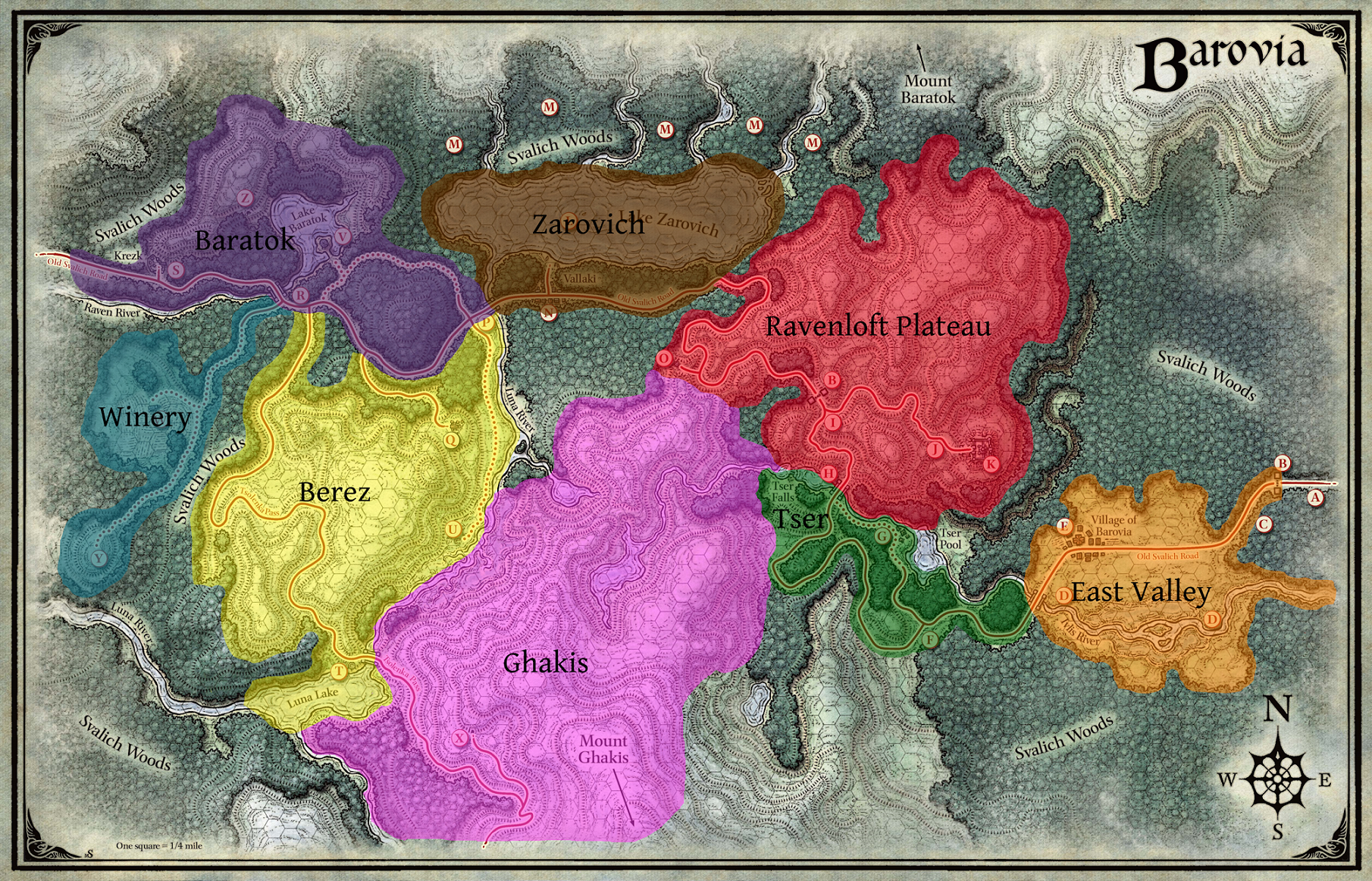
    They also found half a map of Barovia hanging in a study, as well as old town ledgers (where they were able to find that the Dursts existed over a hundred years ago – sure it should have been further back, but I’ve made my apologies to Dragna already – and were all listed as “deceased”) and Ismark’s journal, which confirmed his story and illustrated his dedication to the position of Burgomeister. I am a very visual person and when I’m describing geography in particular, I tend to get my words mixed up. Having a diagram or a map, even if it may impact the intended tone to one extent or another, makes it much easier for me to avoid any confusion. Unfortunately by now I’ve forgotten where I found this map so I can’t cite my source, but I do really like this one – it’s enough to give an idea of the lay of the land, but doesn’t spoil anything inadvertently.


    After receiving the books and map the party went off to sleep, where Madame Eva popped up in their dreams to remind them to pay her a visit in Tser Pool. They woke up to see ghostly green light through the cracks in the wood-covered windows (despite Fang’s warning not to, everyone absolutely looked) and were able to watch the ghostly March of the Dead move from the cemetery around the town and disappear into the woods, and then reappear at the top of the cliffs – with Tallet’s solid Perception check she also noticed the dozens of bats watching them from the roofs of the nearby houses. Fang used the moment to sneak out, break the mirror in the washroom (not like his luck could get worse, given his rolls), and tie a piece to the pommel of his sword after peeking on Ireena with it to verify that she was not, in fact, a vampire.

    The morning saw them being woken up bright and early by Ismark to carry his father to the church. I had completely missed including Muriel when the party first entered the town, so I took the opportunity to place her first appearance here. The party was already on the lookout for anything strange on the roofs after noticing the bats during the night so they noticed her quickly, and it gave Ismark an opportunity to mention that ravens were a good omen in Barovia. He’s a handy device for providing some exposition – he had another chance a moment later, as the party passed through the town square, where he asked them to pause a moment at the statue of his grandfather, Ismark the Great. It was a good chance for me to show off the part of him that aspired to be similarly great, and the self-doubts he carries after the town was besieged.

    At this point I hadn’t yet realized the conflicts between the backstories I had had the party put together for themselves and the module, and Hoid’s came into play as they got to the church – his wound throbbing in pain as they crossed the threshold. The idea was that it would hurt worse when in the presence of a vampire or their spawn.

    The party really didn’t seem to know what to think of Father Donavich when they met him – they were easily able to figure out that he was hiding something, especially when Doru started wailing, but the immediate conclusion was that he was concealing something for malevolent reasons, and my attempts to clarify lead them to believe he was being charmed, or under the control of something else. There was a big lesson learned for me there which I’ll detail further at the end of the arc, but ultimately it’s to make sure to allow the players to believe what they want to believe, rather than to overcorrect by attempting to steer them in the right direction. Ismark was able to settle them by insisting they continue with the funeral out of respect for his father and for himself.

    The funeral scene itself went quite nicely, and allowed me to pull on Luther’s backstory as a cleric, with Father Donavich recognizing him as a fellow man of the cloth. Of course I completely blanked on who Luther worshiped, and mentioned multiple times that he would be familiar with the Morninglord as a follower – completely forgetting that while Luther had received a dream from the Morninglord as his personal hook, he was actually a follower of Ilmater. I brought it up after the session and we decided to just retroactively treat it as Donavich making an assumption and Luther going along with it out of respect, as he would still be familiar with other gods whether or not he actually worshiped them. One thing of note during the funeral scene was a choice I made intentionally knowing the risks that I wouldn’t necessarily recommend – Luther!Player asked if there was a way he could find enough silver shavings to cast Ceremony upon Kolyan’s body to perform a Funeral Rite, which prevents the target corpse from becoming unread for the next 7 days. The party was already concerned that something would happen with the corpse being reanimated, but the spell does carry a hefty – especially for a party with next to no material possessions – material cost of 25gp worth of powdered silver. I chose to allow this to be cast without that cost, as it very much made sense for Luther to do and was a very touching moment, handwaving it a bit as Luther being aided by the spirit of the Morninglord in a small way. I didn’t intend to reanimate him anyways.

    Having finished with Kolyan’s funeral, the party gave Ismark some space to mourn while they spoke with Donavich privately in regards to the elephant in the room, or rather, the vampire spawn in the basement. I think I oversold it a bit, though, as the party went from “let’s kill the priest for keeping something so dangerous hidden” to “we’re just going to leave you to deal with this, it’s on your head”, opting to completely avoid Doru entirely. This, sadly, was probably for the best, as shortly after the session Dragna made some major updates to the Doru and Donavich subplot that would have conflicted with how I was going to run that encounter – the perils of working from a work-in-progress guide popping up once more.

    While planning this session I got some great advice from Dragna on how to handle the very popular additions of Rahadin delivering Strahd’s condolences, or Strahd himself appearing. I had intended to have Rahadin show up, pay his respects to Ismark and offer a reprieve for Ireena to mourn, but make it very clear that Strahd would be returning the following night for her and nothing would stop him. This was to both put the fear of Strahd into the party, as it were, and to shift the timing a bit so the party could rest that night and depart the following morning with Ireena. Dragna raised some good points – Strahd isn’t, and shouldn’t be implied to be, omniscient – the party needs to understand that while he’s extremely knowledgeable and resourceful, he’s doing so through spies and magic, not omniscience, and thus can be deceived. I dropped that entirely and instead had a bat fly out of the nearby woods up to the castle, which allowed Donavich to give some context that bats are a bad omen – while I’m sure the players had already made the assumption that bats = vampires in one way or another, this made it concrete.

    From here I had Ismark leave the party to their own devices as he returned home to mourn. The party wanted an opportunity to do some shopping, and I was really excited for them to meet Bildrath, so shopping they went.

    If I regret anything about the party’s interaction with Bildrath it was not having him try to gouge them enough. As it was, I played up Bildrath being a nasty, angry old man as much as I could, breaking out my best angry Scot voice (it’s so much more fun to insult people in a Scottish accent, if you ask me). This was a lot of fun for me, I’m not going to lie – at one point, Hickory tried to barter using some of the material goods they had retrieved from Death House, particularly the ivory hairbrush. Bildrath, who I described as balding, launched into a tirade at her – “Do ye think ye be a bloody comedian? A hairbrush? Ye jus’ tryin’ t’ insult me? Look at me damn head, ye bloody fool girl, do ye see anything I might be wantin’ tae brush?” It was an absolute catastrophe for the party, and a complete riot at the e-table, and the party, as expected, was soon ejected by Perriwimple.

    I did throw the party a bone, though, as upon their return to Ismark’s manor they were provided with a backpack and the map from above, and in the interest of keeping things moving, the party headed off towards Tser Pool, a now armed Ireena in tow.

    Up next, the party meet some new friends and have… Tser Pool party?


  • I want to take a quick step away from the campaign summaries and talk about the most important tool in my DM prep arsenal, Notion.

    I was originally given the idea by Sly Flourish, who made a Notion project template that works with his Lazy DM approach – I found my style of prep is a bit different from his, but the tool itself is fantastic for organizing my scenes, characters, ideas, etc.

    Notion itself is a general-purpose collaborative workspace – it’s similar in a lot of ways to some of the corporate project management tools I use at work, like SharePoint or Jira, but with a huge amount of flexibility and features. The general concept of it is that every individual piece within your workspace is a “Page”, and each page has a number of different components to it, both data and metadata. Their standard examples are for managing project tasks, or tracking marketing information and data, and other similar things, but with a bit of creativity it works really well for D&D – either solely for the DM or collaboratively.

    Mine is very much in a state of constant evolution as I find what works best and what doesn’t work well for me, but I’ve got it to a place where at very least I’m real proud of it and find that it’s working well.

    The heart of my Curse of Strahd Notion workspace is the Campaign Database. Every individual piece of information – the individual Pages – exists in here, categorized with a host of metadata to keep it organized. This is what the full view looks like:

    It’s kind of a mess from that perspective, but the real use is the different database views I’ve got set up. Now, Notion doesn’t quite use a typical database – it’s very much a database-like representation of things, which took some time to click with me. Professionally I work with databases all day so I’m used to a lot more granular control and other features, but once this clicked I found it worked real well.

    The two most important views of the database I use are the “By Location” view and the “Scenes” view. The first shows me everything organized by where it’s physically located in Barovia, and the second allows for a more chronological approach.

    For the Location-centric view, I first started by taking the map of Barovia and dividing it up into regions. They’re not necessarily canon by any stretch, just purely for my own purposes:

    Using that as I starting point I was able to build a view that breaks Barovia down into a nested list of regions, locations, and sublocations with all of the individual scenes, NPCs, and enemies found in each:

    At a glance, I can see that there’s three primary locations within the East Valley of Barovia – the east leg of the Old Svalich Road, the Durst Manor, and Little Barovia (the nickname I’ve given the town of Barovia to help out my easily confused players). I’ve got Little Barovia expanded, and I can see a bunch of different pages nested within it – a few Locations, a number of Scenes, and a number of NPCs.

    Now, as I mentioned, every distinct piece of data in Notion is the same on a fundamental level – they’re all different pages. What I’ve done is given the different types of pages different tags so I can organize them – and even better, I can assign multiple tags to different pages.

    Little Barovia is both a Scene and a Location – it represents a specific physical place in the world, but it also has specific narrative content. The Town Square, however, doesn’t have any specific narrative scene attached to it, so it’s purely a location, and I can tell at a glance that it’s only in there for organization. The little page icon next to each name indicates whether or not that page has any content. Also at a glance I can tell which Sessions involved that item, how much (if any) XP is associated with that scene, and a handy checkbox for whether or not I’ve covered it with my players. From that view I can see that the players received 500XP when they left Barovia, but they didn’t visit Mad Mary at her house or meet Doru.

    So this seems all well and good for organizing, but where’s the content, you ask?

    Opening up each page – either in the standard “side peek” view I use most often, or in the full view – gets me to the juicy details.

    The top half is all the metadata – the different tags, the narrative arc, etc. It’s mostly self-explanatory – “Number” is just a field for ordering the scenes within a session, and not really overly relevant to the Location view.

    Below that are the different subitems. I can see all the different pages directly linked to this one, so if I were to open it as a full-page view instead of the side-peek I’d still be able to navigate.

    Scrolling down I get to the actual content blocks. Scenes tend to be pretty straightforward, just text that I’m either reading aloud or keeping handy for reference.

    NPCs, on the other hand, get a bit more involved.

    Here’s the first part of Ireena’s:

    It starts off with notes about the character overall – where they were first encountered, physical description, personality, etc.

    Past that we start to see one of the other nifty features in Notion; Page Templates. I’ve built an NPC/Enemy Stat Block template that I can just copy and paste all the stats into:

    There’s a small table on the side for the ability scores that auto-calculates the modifiers in case I want to tweak something on the fly, and below that I’ve embedded art for the NPC so it’s easily accessible to copy + paste into Discord to show my players. This is the empty template, which I can create with a click when adding a new page:

    The other high-level view I use often is the narrative, chronological perspective:

    This gives me all the scenes, grouped by the narrative arc, in order that they’re presented to the players – initially it’s the order I plan to present them, and then I go back and revise the numbers in case things happen out-of-order. This was the first arc, covering the party’s entrance to Barovia and their exploits in Death House.

    Death House itself, being a more traditional dungeon format, didn’t get the same sort of narrative scene structure that, say, visiting the Burgomeister’s Manor did – it was easier for me to just toss the descriptions of each room into a page for that floor instead of flipping between pages.

    When necessary, I can link directly to a page from another for an enemy or an item (although I only bother with creating pages for items with descriptions).

    I can just click the link and get taken to the page for the item, and when necessary I can make them externally visible for players – here’s what the players would get for the letter to Mrs. Petrovna.

    So far, this all works great for planning and organizing everything at once, but there’s also a system I’ve got in place – and this is the biggest remaining portion of Sly’s template – for organizing individual sessions.

    At the top I’ve got my recap blurb that I read at the beginning of the session, then a handy list of the planned scenes that I can check off as I go along. Beside that is any potential XP sources in that session – that’s tied to a second database where I’ve got all the XP values (with a few adjusted in the first Arc to bring them into parity) that keeps track of their overall total.

    Below that is a quick reference for relevant locations:

    Greyed-out entries aren’t specifically relevant but contain sub-entries that are.

    That’s pretty much the bulk of it. The overall scheme is constantly changing, but I’ve got it at a point where I can pretty easily find any information I need. Overall I can’t recommend it enough – while it doesn’t have the D&D-specific features that something like Legend Keeper or World Anvil does, that also means that it doesn’t lock any of those features behind subscriptions or paywalls. It does take some work and ingenuity to make it your own but the flexibility it allows for is fantastic.


  • Session 6

    And so, the party made their escape from the cursed Durst Manor (with only one Limp Bizkit joke!) and into the “safety” of Barovia.

    This was the point at which I switched over fully to DragnaCarta’s Curse of Strahd ReReloaded. There’s still a loose end here and there that needs to be tied up to get everything in line, and I will need to make a small addition in one or two places (Sorry Dragna – Jeny Greenteeth’s gotta come back, but don’t worry, she’ll just be a shopkeep). This will tie in directly with Lesson Learned Number One after all of the arc’s synopses – a bit of a departure from what I’ve said previously, but rather than trying to recap the entire arc I’ll just go bit-by-bit. Milk it for all it’s worth!

    Exiting the manor, the party found themselves looking out across the valley, still covered in fog but much less obscured than in the previous morning. With the version of Death House I had run, they had entered early in the morning, around dawn, and escaped around noon. I hadn’t quite caught on that Dragna was using RAW distances so they had a fair bit of uneventful walking to do which worked out, as they reached the ramshackle walls of the village at sundown.

    When they reached the village, Tallet the door monkey immediately wanted to try every door – oops, turns out in my Barovia, even when they evacuate the village to go elsewhere they lock their doors. Otherwise it would have been a session of “you find yourself in another empty house, belongings hastily packed and taken away, and no you don’t find anything useful”.

    Regardless, they eventually followed the only sign of life in the town (despite wondering where on earth they could possibly go if everything is locked – sure, a little bird could tell them like the guide says she should but I totally forgot all about that) to the town square, and wound up at the Blood on the Vine Tavern.While little attention was paid to the Vistani women at first, when they left Hoid felt driven to follow them out of the tavern and see where they went (off into the mists, down the road). When he returned Luther had purchased a pitcher of wine and Ismark had just approached the party, and all seven of us learned how poorly I can stick to a vaguely Slavic accent – so Ismark now has my standard “serious male voice” that I do so love using. In lieu of a full “lessons learned”, I’ll offer this – sometimes, especially when playing digitally and audio can be impacted, it’s not always worth it to go for immersion with an accent, even if you’re good at it. Instead what I’d recommend is looking at Laban Efforts – that’s a fantastic video that breaks it down super well.

    After a brief chat where he was able to somewhat prove he wasn’t an immediate threat and could be trusted, he explained the essential situation – he needed to get his sister out to Vallaki because he couldn’t guarantee her safety in the town. Hickory took an opportunity to ask him about the letter she carried, showing him only the back of it (a mostly illegible ledger from the Blue Water Inn). He was quite mystified as to how it could have gotten out of Barovia at all, and his best guess was that she had to have been given it from someone from Barovia – but did comment that if he were to recommend anywhere in Vallaki for hospitality, the Blue Water was first on the list (albeit a very short list as he’d never been to Vallaki).

    He then brought the group back to the manor, pointing out Bildrath’s shop on the way, letting me send some deliciously mixed messages afterwards when I was hinting that they could check it out if they wanted to – “wait, should we go there? Shouldn’t we… not go there?”

    Arriving at the house, I got to introduce my sassy takes-no-shit, loves-her-dear-brother-but-lord-does-she-have-no-more-patience-for-his-airheadedness take on Ireena as Ismark – who’s come to trust the party just a little too quickly – nearly invited the party inside before she tore him a new one, pulled him inside, and waited impatiently for the party to catch on. It only took a couple impatient sighs and a “I’m not going to invite you in, you know” before it clicked and Fang marched inside, the rest of the party close behind. They were very suspicious of Tolyan’s coffin – their previous experience with dead things that didn’t quite stay dead had made an impression – but the two were able to reassure everyone that no, the biggest risk from that was the smell.

    They took up seats around the fire in the manor’s sitting room as Ismark fetched some food for them, chatting with Ireena and quickly cutting to the chase and asking about her scarf. Personally, I didn’t feel that she would continue to hide it when the party knew the gist of the situation – Luther was curious as to the extent of her “languishing” as described in her father’s letter. She revealed the bites, and unsuccessfully tried to convince them that she was not, in fact, a vampire at that point. The party pretended to go along with it, but Fang did verify it later with a broken shard of a mirror. Ismark returned with a tray of food – described as a charcuterie of field rations – and a pot of tea, and as Fang inhaled the contents of the tray Ireena dragged Ismark back to the kitchen under the guise of lambasting him for forgetting teacups while actually reaming him out once more for trying to ship her away. While Mister 24 Passive Perception Luther did hear that they were arguing he was far too polite to eavesdrop so they did miss the content of it.

    The two returned, Ismark looking upset while Ireena looked relatively put together (once again, Luther was able to tell she wasn’t – gotta love Observant), and Ismark presented the group with the other part of the request – helping bury Kolyan in the morning. Hoid felt it was the respectful thing to do, and Fang (presumably) felt it was a sound tactical move, so they agreed.

    From there, Steve lore-dumped Ismark regaled them with the story of the recent events that happened in town, effectively verbatim what was in the current RRL draft at the time. Downside was in that version, Mordenkainen was the “outsider” involved, but I lucked out and didn’t mention him by name or really give any details that really conflicted with the current version using Van Richten (which is great, since Fang is specifically looking for Van Richten). He also gave them a bit more detail about Strahd’s visits, and Ismark and Ireena’s belief that while she had been bitten twice, Strahd intended to “finish the job” with the third bite.

    At this dramatically convenient point, a knock came at the door, which Tallet immediately ran off to open. I called for contested Dexterity checks as Hickory attempted to grab her, but she succeeded and flung open the door allowing Mad Mary to waltz in, at which point Ismark – who hadn’t quite beat her, but rolled high enough – was able to grab her and move her away from the door. Mary ranted for a bit about her poor little girl, Gertruda, who had run off and nobody was trying to help find her. The session was running long, so Ireena pretty quickly calmed her down, ushered her out, and broke down in tears – I had Ismark inform the party that “little girl” was a bit more metaphorical while “Mad” Mary wasn’t, as Gertruda was of similar age to Ireena. I left it pretty open-ended as far as what had happened with her in actuality so the Doru subplot can still be worked in. After all that, I sent them off to bed to end the session…


  • Sessions 2-5

    And so our brave party found themselves in the Durst Manor, more widely known as Death House.

    I’ll start this off by saying that I really didn’t love Death House. It took almost 5 entire sessions to run over almost 4 months – biweekly sessions, broken up by a tonsillectomy preventing me from being able to talk for more than a few minutes let alone run an entire session, were the culprit there – and I made a lot of little mistakes that just wound up making it more stressful than fun to run. Don’t get me wrong, the players all had a great time – at worst, it was a 6 or 7/10 experience, but I was really hoping for a solid 10/10.

    The biggest contributor to my little mistakes were trying to experiment when I barely had the confidence to run it as written, or at least as written in at most one guide. I bit off a bit more than I could chew with it, trying to piece together bits of Mandy’s, Pyram’s, and Dragna’s guides – and not just one of Dragna’s, but I started pulling from Rereloaded as soon as there was a sneak peek of it available. Not a good call by any stretch.

    I’ll keep the synopsis on the briefer side (yeah, right). I quickly learned that Tallet!Player had a bit of a reputation in her other games as being a tad excitable when it came to opening every single door she could find – which immediately meant that the door mimic in the basement was back in. Unfortunately, she had bee-lined straight ahead to the dining room door, and Fang – who is apparently always hungry – absolutely had to sample the feast. Fortunately, that got me this wonderful audio clip:

    The party from then on decided to be overly cautious about touching anything in the house – avoiding anything that could be used as a weapon, aside from the longsword and shield. Fireplace pokers? Nope. Kitchen knives? No good. The crossbows locked away in the den? Didn’t even look.

    They did make their way up to the second floor quickly enough, getting there during the first session and scoping out the study first. Hoid landed a fantastic investigation check poking through the bookshelves for anything of note, which it made sense to reward him with the hidden lever for the secret room as well as “The Life and Death of Hoid”. Unfortunately part of his backstory involves him being a runaway noble who’s worked hard to keep that a secret, so rather than reading it he immediately stashed it away – which kinda killed that little tidbit. To top it off he had done that before the desk was investigated during session 2, so the note that would typically clue them in to the book was now extremely confusing. They had no idea who Bulwarton was, what words were his, or which way they would lead, but had already found the secret chamber. Not a big problem of course. The first session ended after Luther found his new bestest best friend Lancelot who the party initially refused to trust (“I swear the dog is a vampire!”), but quickly turned into a mascot of sorts. They then moved back downstairs and Fang – leaning wholeheartedly into his whole “I’m an experienced adventurer, just not a very good one” shtick – tried to smash a window for an escape route, failing his CON save and taking a level of exhaustion.

    The next session found them exploring the first two floors quite a bit more after some subtle hints from me that certain objects may have uses as weaponry, and they did finally find the crossbows and a few kitchen knives to use as daggers. Hoid, wanting to bard as much as a bard can, took the bait once the sheet music was found and I had a lot of fun describing the ghostly dancers, with Mr and Mrs Durst staring daggers at him throughout, although I did discover that running pure Theater of the Mind doesn’t do any favours for players that already aren’t great at spatial reasoning. Took a bit more explaining than it should have to get them to understand where the grinding noise and the click had come from after he finished playing. I do definitely regret letting Fang and Luther take some time to salvage two sets of scale mail from the suits of armor on the second floor as per Mandy’s guide, especially after nixing Hickory (a 14-year-old girl) using the leather armor from the hidden chamber in the study (made for a full-grown man), but fortunately Hickory!Player isn’t actually upset about it – he just enjoys pretending to be salty over it.

    Session 2 ended with the Animated Armor encounter which went really well, in all honesty – it got some solid hits in, and the party didn’t burn it down too quickly. Hoid’s Vicious Mockery insulting the armor to death was a particularly entertaining end.

    The third session finished off the house proper as they continued to explore the third floor and the attic. I was still using the original Reloaded at this point and they found Mr Durst’s ghastly body hanging in the room which was suitably morbid, and Luther got to be the holy man he meant to be, performing his last rites. Hickory snatched up the jewelry box and its contents which meant I got to remind her that she was dragging along her spellbook, the three books from the hidden chamber, the three spell scrolls, plus the jewelry box and her weapons without any sort of bag to carry it in. All in jest, of course – I didn’t enforce any mechanical impact from it because as I touched on previously, that’s just not very fun.

    Meeting Margaret was great – I’m really glad the overwhelming consensus is to turn that into a social encounter, not a combat one, as it adds a lot of flavour to the house overall. I did leave the option for combat open but they didn’t go for it, sadly. It was a bit of a head-scratcher describing the mirror that hides the attic stairs hanging open and the party moving up, and then immediately hearing “hey did we ever find out what that grinding noise was?” Yes. Yes you did, I told you a few times, even explicitly once you found the mirror. My party’s true nemesis is information retention, it seems. Which popped up again after Hickory used the key from the study to unlock the children’s room, yet later started wondering if they would find the lock it went with…

    Running the actual Rose and Thorn was a lot of fun, I really enjoyed completely changing Rose’s personality from the scared little girl outside to the much sassier and confident ghost indoors. As soon as one of the players started poking around at the doll house she popped out with a “Don’t touch our stuff without asking, that’s very rude!”

    Rose made them promise to lay their bodies to rest down in the basement crypts, which was very quickly forgotten (in no small part due to the long break between sessions, unfortunately) and they moved off to find the hidden button for the basement stairs, running across Margaret’s body and another encounter with her in the process. They also got very sidetracked trying to figure out what was up with the two creepy dolls in the spare bedrooms – I had put identical ones in each, with the implication that it was the same doll – as well as getting fixated on looking for any clues of guests that may have been staying over in said rooms. “Hickory wants to look around for any sign of an active guest when this all went down.” “The beds are made, there’s no belongings of any sort besides the furniture and the dolls, everything is pretty evenly covered in dust.” “So there’s no, like, luggage or anything, then?” “Correct, no personal belongings, just a creepy doll.” “You’re sure?” “Well, you rolled an 18 on your investigation, so I’d say that Hickory’s pretty sure, yeah.” They did finally move on, ending the session as they descended into the basement and leveling up to level 2.

    Fang took the lead in the basement, immediately declaring he was going to follow the left wall to not get lost, and completely missing that the first rooms he looked into – the crypts – each contained a seemingly empty child-sized coffin that the two tiny skeletons he was lugging around would likely fit perfectly in. While they wound up skipping the lower right section of the map entirely due to sticking to the left, they did thoroughly investigate the cultist quarters, finding all the available loot there, much to Fang’s chagrin (and of course, Hickory further filled her little arms with loot).

    The ghoul encounter went well and was handled pretty easily, with the party retreating down to the second level mid-combat (although they were able to finish them off before actually heading down). A few more fantastic investigation rolls later and they had bypassed the portcullis via the hidden door in the prison and entered into the ritual chamber. This is where probably my biggest misstep was – I described the dagger being on the dais before they moved onto it, and Tallet grabbed it with her Mage Hand. Fortunately Fang being Fang grabbed her and jumped over to the altar to put the dagger back, triggering the encounter, but due to time we ended the session then – leaving it on a big ol’ month-and-a-bit-long cliffhanger as I soon had to go for my tonsil removal and spend a few weeks recovering.

    During those weeks Dragna dropped the first draft of Rereloaded, at which point I switched over to using it almost exclusively for content. That meant I got to use his new Walter the Flesh Mound stat blocks which was a lot of fun.

    Session 5 was entirely the combat encounter with Walter and the escape from the house. Top marks for the stat block – given the size of the party and some of the buffs I had given them (the scale mail, the first-level feats, etc.) I dropped the Heavy Sleeper feature from it, and also tossed in Mrs Durst as a ghast plus a couple of ghoul buddies to add a speed bump, and it worked great. Fang tried to buy them time to get the portcullis open (I slammed the secret door shut as Walter woke up, and the investigation check to find it again went very poorly) by going toe-to-toe with Walter, almost immediately getting engulfed by him. Luther and Nomuri hung back in the entry to take potshots while the rest made their escape running headlong into Mrs Durst and friends. To his credit, Fang almost single-handedly dropped Walter down to his second phase before Mrs Durst was slain and the party was able to escape – I did skip one Engulf action just to not entirely kill him (yet), but other than that no punches were pulled.

    The skill challenge on the way out did not go well on my end. Hickory was up front the whole time, and fairly easily passed each one, so I wound up just giving it to them rather than belabouring an already long section and wanting them to move onto the real meat of the campaign. They soon found themselves outside, a gift basket with a bottle of wine and a note reading “Welcome to Barovia” and signed with an ornate “S” waiting for them, and we ended the session there as they went up to level 3.


    Lessons Learned

    Oof, tons of learning on my part here.

    Number one is the biggest thing I’ve struggled with, and I feel a lot of DMs do in general.

    Players aren’t stupid – at least, I know mine aren’t. But they’re far from perfect, and they’re nowhere near as aware of their surroundings and environment from purely verbal descriptions (plus the odd reference art image) as they would be if they were there. It’s almost a foregone conclusion that whatever cleverness you’ve come up with as a DM that normally they would have no problem with solving will be extremely difficult to figure out.

    They’ve each got their own preconceptions about where they are, what’s around them, what you’re trying to describe, so on and so forth that aren’t necessarily remotely close to what you actually said or described, let alone what you meant to describe – because not only are the players imperfect and distracted and running on their own imaginations, so are you.

    Just because something should be obvious doesn’t mean that the requisite information they’d need to let it be obvious has actually made it to them – so don’t be coy or vague about information they should justifiably have and need.

    Hoid found the lever to the secret chamber that was disguised as a book by Bulwarton. Hickory later found the note saying “Bulwarton’s words will lead the way”. It’s easy to assume that Hickory should have been able to put two and two together and say “Oh, the book/lever had that name on it, so that’s what it’s referencing”… but Hickory!PC didn’t hear me say “Hoid, as you investigate every book on the shelf quite closely, you pull one labeled ‘Bulwarton’s Guide to Barovian Architecture Vol 3: Secret Passages’ and a secret passage opens up”, because why would he? I never told him I was talking to him or his character, he just heard ‘blah blah blah SECRET PASSAGE OPEN blah blah blah’. And that’s assuming I had actually remembered to say it was a book written by Bulwarton given that I was in the middle of trying to herd half a dozen cats.

    What I should have done when Hickory found the note was describe it as such:
    “Hickory, you find a note on top of the desk that says ‘Bulwarton’s words will lead the way’. Hoid, you overhear Hickory reading that aloud and recognize the name from the book you pulled to open the secret passage – that would likely have been what it was referencing”. Problem solved. They’d already solved the puzzle so they haven’t gained anything from that knowledge, and I get to avoid having to explain it.

    Similarly, the makeshift weapons very much could have been explicitly mentioned – something I did correct once the players decided to return to the first floor and go over it once more. Now, I love MandyMod’s guide in theory, but in practice I’ve found it’s not the exact type of CoS I really enjoy running – I’m going to continue to draw on it for inspiration in general but Dragna’s is working out to be the one that works. This was one of her additions to it.

    My players have played very typical D&D before – at least, those who have a good bit of experience. And I don’t know if it’s true at every table, but for theirs if it’s not called a “longsword” or a “club” it isn’t a longsword or a club or what have you. So when my players, despite being largely weaponless, heard me describe the fireplace on the main floor as having a set of fireplace pokers that looked like they could be used as weapons, their immediate thoughts were “well, improvised weapons suck, so… that’s cool I guess?” because that, at least for them, is generally the case.

    Had I explicitly said “The fireplace has a poker leaned up against it, which looks like it could be used similarly to a sickle or a club” they very well may have grabbed it – and this was even after I had told them “hey, you’ll have to be creative, there’s things in the house that can be used as weapons”.

    Like I said, when they came back downstairs and started looking around in the kitchen, I did just that – “There’s a pair of kitchen knives that look like they would work as daggers”. Shock and surprise, Hickory and Hoid each grabbed one.

    Then there was the biggest one. I made a big deal out of Rose and Thorn asking the party to lay them to rest in their coffins downstairs, and the party took it to heart… that session. Two weeks later, when they got down to the crypts, all of them completely forgot they even had the bodies with them. I described the empty child-sized coffins, assuming they’d remembered, and was delighted when a player asked “…and you said they’re empty, right?” and assumed the wheels were turning. Turned out, nope – they just wanted confirmation that there was nothing in there that was interesting and moved on. I figured they’d remember by the time they got to the stairs down… and nothing. And by that point I had completely forgotten about it myself, what with having to actually run the game and all. I did remember afterwards and said something about the kids bodies in our Discord, to which I got a resounding “…bodies? what bodies? …oh. Well, we’re still here, we have time.”

    This session had, as a reminder, ended right when they woke up Walter from his nap. They did not have time.

    I did throw them a bone, though, and let them drop the kids off in their coffins (luckily, right across from the stairs leading back up) during the escape – they got a nice pat on the back from the kiddos ascending into the afterlife (lol not, welcome to barovia) after they exited. Once again, all’s well that ends well. “Don’t metagame” runs both ways, and needs a lot more nuance – players shouldn’t use information from out-of-game that their characters wouldn’t have, but they also shouldn’t be punished for not remembering things out of game that their characters would. Maybe this is a controversial stance but I firmly consider doing so to be the definition of “antagonistic DMing” and not fun. At the end of the day, this is a game, and games should be fun.

    It’s still a work in progress, but reminding myself to just say the things they should feasibly know, and not assume they remember them.

    The next lesson was one that should have been obvious. If you’re going to try out a new thing, make sure you know what the hell you’re doing. I’ve never run a skill challenge before, and I’ve only seen them run a couple times – mostly on Critical Role and the like. I was way overconfident that I had all the information on how to run it… but I didn’t. All the reference info I had on hand was Dragna’s draft for Rereloaded, which fortunately has been updated, but wasn’t exactly exhaustive at the time. To be clear I don’t fault Dragna for this at all, it’s firmly on me for not making sure I knew what I was doing. I skipped the portcullis, as I wanted them to try fighting Walter for some reason and had thrown in Mrs Durst as an enemy (I definitely prefer Dragna’s idea of her being a force rather than a physical enemy). Hickory was already up front, and being a rogue nailed the DEX save for the pit. I missed the whole “pick a different active player” part (and the ghoul bones and the hands coming out of the walls), so she got the next one too – the wave of insects flooding out from a crypt. Of course, I had no idea where the insects would go after a successful save (and I assume this is why Dragna removed it) so they just swarmed out across the hall into the crypt opposite and into the wall there. I got the whole group to do a save moving up the stairs as the blood rushed down, and I don’t think a single one of them rolled below an 18. Then, once in the attic, roots began to attack the from the windows, with Fang being the one to nearly get caught (and succeed on a save for one of the first times so far this campaign). Lastly as they moved back down through the house, they came across the whispering darkness of the balcony – Fang had Devil’s Sight, so he was able to tell the party confidently that he couldn’t see anything there, but you can’t really see whispers. He did pass the save though. That made 5 saves overall which was enough for me to say “fuck it, you guys are able to make it out of the house before this stops being fun”. Of course, I had phrased it a bit more flavourfully, but still.

    Third, Theater of the Mind in a relatively complex 3D map where the layout matters is hard. It doesn’t help that the map is “sideways” with North on the left-hand side which got confusing pretty quick. Six players that are all easily distracted in their own ways only adds to the problem.

    For sessions 1 and 2 I went onto Dungeon Scrawl and drew out what they had explored up to that point, which looked great but wasn’t overly useful while they were in-game:

    I wound up installing the Dungeon Draw application and drawing out the house levels live with that:

    As you can pretty easily tell, not the prettiest. That would be the 3rd floor and the attic – I had also loaded a handful of custom tiles for stairs that didn’t quite make it into my Foundry 11 install (I might have to do a post about that on its own) which helped, but there were issues trying to get adjacent rooms to stay adjacent rooms and not become a single large one. Probably user issues, but issues nonetheless which distracted from the game.

    For the basement I essentially said “screw it” and found a map (I’ll have to find the source to properly attribute it):

    As you can see, I opted to not give each player their own token – with 6 players, some of whom get real excited as far as maps and tokens and the “video-gamey-ness” of it go, that just seemed like a recipe for a bad time. Instead, I had a single group token (with li’l ol’ Lancelot in the middle) that I controlled – I had the players describe where they were going and moved it around as a “camera” of sorts. That way they had a visual reference for the layout but it was still effectively TotM. That worked really well, even for the combat – I’d ad hoc toss in some “X”s on the map to indicate where the enemies were standing (and used actual tokens for the Walter/Mrs Durst encounter) but they were still able to describe narratively where they were in relation to the enemies and each other without getting hung up on the grid.

    That said… I’m probably switching to combat maps from here on out for the most part. They recently encountered the Strix outside Tser Pool which was fine as purely theater of the mind (it was airborne, they killed it before it got to the ground) but otherwise, tokens are a bit easier for combat in my experience. Exploration in dungeon maps I’ll still likely do as above, adding extra “observer” tokens if and when the party splits up, but for actual combat I’ll just throw everybody down. Chances are I’ll switch over to exploration with individual tokens but I’m not sure that I’ll give players full control over them – we’ll have to see how it goes.

    There were a few other lessons as well that don’t require quite as lengthy of writeups. Like, as a DM, try shutting the fuck up. Prompt the players, and then just let them go for a bit, and once it feels like it would be the most impactful (or, more likely, once they run out of steam) then pipe up. Another good one is to make sure you players understand the basic mechanics of combat and don’t be afraid to say “no, but…”. Hoid!Player is new to 5e and the Action/Bonus Action/Reaction/Movement system isn’t something he’s completely grokked, but he’s very inventive and creative as far as coming up with things to try… unfortunately, sometimes they tend to be things that either would be a waste of a turn or way too much in one turn. He was in the group fighting Mrs Durst while they were escaping from the basement, and on one of his turns he said that he wanted to try to use his Actor feat to mimic the voices of the children to distract her. I figured, sure, that’s basically using the Help action, and had him roll Performance. He rolled a 21, so I ruled that the next attack against her was with Advantage, and on top of that her next attack would be with Disadvantage. Then, however, he said “While she’s distracted, can I try to pick her pockets?” I blanked for a second – I had described her as wearing tattered robes, but more specifically I was picturing something very basic – nothing that would have any visible pockets let alone any other visible belongings, and all decayed at that. I clarified it, but made the mistake of saying “Sure, but you don’t see anything on her, or any pockets to dig through.” He insisted that he’d like to try, so I asked for a Sleight of Hand check, and he rolled a dirty 20… and I realized I hadn’t considered what would happen on a success, let alone a high roll like that, especially that I had clarified that there wouldn’t be anything to find. Saying so wound up feeling pretty disappointing, as if rather than rewarding his creativity I was pulling the rug out from under him. In retrospect, I should have been firmer – distracting her by throwing his voice was using his Action for the turn, and to try and pick her pockets even if she had any would require a second action – allowing him to even try to do both shouldn’t have even have been on the table.


  • Session 1

    I’m going to divide these posts up roughly by narrative arcs, rather than sessions – this post will cover the first part of Session 1 as the party enters Barovia, and the next will cover the rest of the session up to the end of Session 5 when they exited. Makes a little more sense to me to do it that way.

    So, Session 1. I’ve already gone on a bit about the Session 0 “pre-campaign” events that led them to the Nightmare’s Stable Inn near Daggerford, on the edge of the Misty Forest, so I won’t dwell on that further. The session started with the party already on the road in the Vistani trader Stanimir’s wagon, about an hour out from sundown, and I had them each take a moment to describe what might have happened the previous night as they all sampled some imported Barovian wine, as well as how they were currently handling their hangovers.

    Once they all got their introductory descriptions out of the way the sun was setting and they pulled up to a camp with a few other Vistani and got their first taste of Vistani hospitality – food, wine, and stories – before going to sleep. Nomuri, as expected, snuck off to get his final (unknown to him) hit of Dragongrass before bed, and the ever-paranoid monster hunter Fang set up an Alarm spell around the area just in case of threats – Stanimir did politely let him know it was unnecessary, but no harm, no foul.

    Then the fun happened as the fog set in.

    They woke up in the morning exposed to the elements with only minimal gear. As two of the characters were young girls, I opted to let everyone keep their clothes rather than taking literally everything they weren’t wearing to bed, but not much else – their token items, a coinpurse or waterskin, their trinket I had made them roll for off the list (or let them come up with), a class-dependent item if there was one, and of course the Tarokka cards Madame Eva had left them with after the previous night’s dreams. Here’s the full list of what they were left with:

    Hickory – traveler’s clothes, spellbook (from Ritual Caster feat) with the letter from “her parents” tucked into it (her “story token” item), silver necklace (trinket), coinpurse with 10GP
    Fang – common clothes, Silvered greatsword (token item), arcane focus (a necklace), silver coin keepsake (trinket), waterskin
    Tallet – common clothes, amber shard (token item that doubles as her focus), waterskin
    Luther – common clothes, vestments, shield/holy symbol, prayer book, incense (I let Luther keep his religious items because I figured that would make some sense), gold coin w/Morninglord’s emblem (token item), waterskin
    Nomuri – traveler’s clothes, pipe (token item), sibling’s necklace (trinket), bag of dragongrass (empty – because I just had to)
    Hoid – lute, fine clothes, signet ring (honestly, more of a liability as he tries to keep his nobility a secret), coinpurse with 18g (Hoid didn’t have a token “item”, but his wound counted instead)

    All in all they were suitably disappointed with the new contents of their inventories, as expected!

    I gave them a few minutes to attempt to get their bearings and then they started to hear wolves behind them, to the east – being largely unarmed (and understanding out of game that they should get a move on towards Actual Content) they pretty quickly headed off towards the gates.

    The Gates of Barovia weren’t overly interesting – definitely some mistrust around them, and it may have just been how I described them or how the party understood me but they didn’t quite grasp the scale of them. “Well, can we walk around instead of through the gate?” “No, the walls stretch as far as you can see into the woods until they disappear in the fog. You can try looking, but the fog is really dense, and you’re still hearing wolves…”

    They finally went through and caught a whiff of poor old Dalvan Olensky, who they patted down for anything he might be carrying, as one normally does with a corpse. I planted a dagger and a shortsword on him to give them something to fight with but that still only gave them 3 weapons between 2 fully martial characters, 1 pretending to be martial, and two half-casters. I think there was some misunderstanding about the language in the version of the letter I used – they very much took “languishes” to mean “is literally seconds from death”. Either way, they promptly forgot about him and the letter (this is a recurring theme) and moved on, finding themselves looking out into a very misty valley with a thunderstorm starting to pour down.

    They hadn’t been heading down the road very long when Mr 28 Passive Perception AKA Luther noticed a light off to the side of the road – and despite Fang immediately throwing out an anglerfish comparison they did opt to head towards it. It soon turned out to be good ol’ Durst Manor – the light itself being a lone lantern hanging in the portcullis over the kids.

    Honestly, they quickly fell in love with the kids, despite being fully convinced they were vampires (and I didn’t even show them the official art!). Fang made a great show of producing a magical flower to win over Rose, who returned it with a “…that’s nice, but we’re pretty sure that a monster ate our parents and our baby brother, think you could, you know, help us out?”

    And with that, they entered Death House, known to them only as Durst Manor (which made for a fun conversation when Hickory!Player mentioned “Death House” later on, haha – he’s cool though, he hadn’t actually read much about it and didn’t meta even if he had).


    Lessons Learned

    A bunch, here. I had a little chat with Dragna earlier today and mentioned that I really preferred how he had done the whole lead up to Death House – stick it in Daggerford, outside of Barovia, for the players to enter there and exit out into Barovia from it. That would have expedited the first half of the session substantially and eliminated all of the railroading I had felt necessary.

    On top of that, I didn’t love taking their gear. The party didn’t quite feel as desperate and scared as I had hoped, and struggled to come up with ways to use things from the environment as weapons – it fostered more resentment, at least towards the Vistani, than anything and lead to a lot of trying to bargain with Bildrath (which I had so much fun shooting down in character as him) to get basic exploration gear and armor. It just wasn’t fun.

    I also learned something about my party in particular – things have to be pretty obvious for it to click. A few of my players are quite ADHD (literally diagnosed as, I should clarify), as am I, so picking up on the little details being described in the flowery language I tend to use doesn’t work super well. Plus a few of the other members tend to be a little inebriated during sessions, which is fine, but definitely leads to issues with retention. I’d much rather they have fun than bring the hammer down so my preferred option is to do things in a way that works for them, rather than attempting to try to enforce certain behaviours that might make my way work. Path of least resistance, plus fun is the priority.

    The other huge lesson I learned in a very painful manner was that if you want to include specific content – like, say, a Vistani story – triple check that you have it ready for when you need it. I wanted to give them a chance to tell campfire stories but wasn’t expecting them to really have much prepared, so Stanimir told them one instead… but I lost the story and wound up telling a very butchered version of Strahd killing his brother, realizing midway through that was not something the Vistani would know, let alone tell. Luckily I butchered it so badly that it didn’t make a difference, but still. It felt rough.

    Just for evidence of how great my players are at notes, this was some of Fang’s from the session:

    To be clear, the word was “fratricide”. Ah well.

    Next time, Death House!


  • So, I’d really briefly like to jump forward to the present time and talk a little more about PC Backgrounds, their plot implications, and the corner I had painted myself into due to them.

    Long story short – I fucked up and got overambitious trying to tie the PCs into the existing narrative without putting enough care into make sure that how I did so actually made sense within said narrative, and in some ways that should have been pretty obvious.

    A number of characters from the PCs backgrounds – whom they had met outside Barovia – should not have been able to leave Barovia, and worse yet, one character (Hickory) was replacing some aspects of an existing NPC (Ireena) in a way that didn’t make any sense.

    So, here I was, 8 sessions in, and completely unsure of how to fix this without impacting things that had been established ingame while still keeping the story satisfying to myself and my players, but entirely sure I had to do something… but what?

    After a ton of brainstorming, I had a bit of an idea – but it was more than a bit convoluted and confusing, and really didn’t feel great. The general essence was that each PC was actually an “echo” of an existing NPC in one way or another and their past events mirrored those of the source NPCs… but it didn’t work very well for all of them at all and I was really unhappy with it.

    I wound up approaching Hickory!Player and gave him the cliff’s notes of what the problems I was worried about were (somehow without providing any major spoilers, although he’s a player I can trust to not meta), and told him what I was thinking as a solution. I was overjoyed when he said he was “leaning towards nothing at all was wrong in Hickory’s young life” as a twist, which was exactly what I needed to hear – what if the tragic events each PC was searching for a resolution to in Barovia never actually happened? Even better yet, this was super flexible – only two characters needed to be “adjusted” that dramatically.

    Hickory had been orphaned and found lost in the woods. Fang was mind controlled by a lich and killed his family. But what if… neither of those things had actually happened, but they had been tricked into believing it by the Dark Powers in order to bring them into Barovia?

    So this is what I wound up with.

    For starters, as per Dragna’s current notes, Strahd himself is trying to escape Barovia and the Dark Powers by using the power of the Fanes via the Heart of Sorrow to “carve a hole”, but is trying to keep it secret from the Dark Powers to prevent interference – I don’t think he’d be able to pull that off necessarily, so I figured… let’s have the Powers interfere. Madame Eva’s aware of the Grand Conjunction, as she had told him about it to start with, so I added another premonition – she had divined that while he would try, a group of adventurers (ie. the party in question) would be the only chance of preventing that from happening. The Dark Powers would also have been aware of this foretelling, and exerted some small amount of influence on the outside world to make sure these adventurers actually entered Barovia.

    The Dark Powers also want to use the party for their own purposes, but keeping Strahd locked in is a priority.

    Maybe Hickory wasn’t orphaned, but was travelling to Waterdeep to visit family and got lost – but her family is alive and well. She just all of a sudden had a piece of paper implying they were dead from Barovia that didn’t exist before. She’d still have been adopted and thought she was an orphan, and tried to find her sibling “Izzy” in Barovia.

    Maybe Fang hadn’t actually killed his family, but was subdued and woke up surrounded by their illusory corpses – and in his grief, exiled himself. He still would have taken up his path of vengeance and been directed to find Van Richten in Barovia.

    Luther and Tallet needed no changing – Luther was brought to Barovia by a message from the Morninglord to search for a “fallen angel”, and he’s 100% a candidate for being corrupted by the Powers. Tallet was saved from stillbirth by a Dark Power that made a pact with her in the womb, so there’s corruption potential there.

    Nomuri was easy – he didn’t have trauma, but he also had the more difficult to explain issue of being smoking buddies with a character that more than likely couldn’t even leave Barovia. It’s easy enough to say that his memory of said smoking buddy being Jeny Greenteeth was a deception in and of itself – she was just some old herbalist that wandered around the area he lived in. The note and the pipe he found? Conjured by the Powers.

    Hoid was also pretty easy, but also might be a non-issue as Hoid!Player may be dropping out of the game due to time commitments – either way, there’s no reason Strahd couldn’t or wouldn’t send a new bride out of Barovia to murder her ex as a show of commitment. To bring everything into parity though, I landed on that while she was sent out, she didn’t go through with it – the stabbing that occured was fictitious, and Strahd is pissed at her after finding Hoid alive and well.

    As far as how I solved this, it was pretty easy (and ongoing in-game). The party just had their Tarokka reading last session, and I added a second reading (actually, the first reading, with the traditional one happening immediately after) where Madame Eva revealed that (vaguely paraphrasing) “dark events of their pasts had risen up to haunt them”, but “the events were not truths but deceptions they had all believed whole-heartedly and though they were told for a benevolent purpose” (ie. defeating Strahd). She also said that “benevolent as they were, they still served an ulterior motive and came at a great cost to each of them that they did not know they had paid” (ie. they hadn’t actually “lost” their families, etc. until they actually entered Barovia and became locked in). She gave a little more detail about how they may be tempted by “the dark” as well as provided aid by allies but the two would be difficult to discern, and more importantly there was just as good a chance of success if they fell into the temptations as if they only took benevolent aid. Essentially, just emphasizing that avoiding the temptations of Dark Gifts isn’t necessarily the “right” choice (well, it is, but I still want to corrupt them, you know?).

    And, well, yeah. That’s about the story so far.

    They’ve just decided to bunk down for the night, and I’m opening up the next session with dream sequences that make things a bit clearer.

    Up next: I actually get to the gameplay, starting with Death House and the lead-up to it!

    If you’re interested, I do record my sessions (when I remember to), and took Madame Eva’s dialogue from the reading, cleaned it up a bit, tweaked the soundtrack, and recorded what the players would have seen (or should have seen if it all had gone perfect, but it still went well!):

    Madame Eva’s Tarokka Reading

  • A good narrative campaign, built around character development, starts with good characters to develop. I had a lot of fun working with my players to build their characters. Initially I was pulling from Dragna’s (plus additional inspiration here and there from his Twice Bitten campaign, taking into account his party of experienced DMs in comparison to mine) and MandyMod’s work primarily, with Pyram King’s and Lunch Break Heroes’ for additional inspiration.

    For this phase Mandy’s was absolutely key. I gave my players Mandy’s Player Primer and some small limitations on player options (no races specific to other settings and a discouragement on monstrous species primarily, and DM approval required) and set them free, and they came back with a bunch of cool ideas, most of which tied in quite well.

    Now, you may read this section and for one reason or another start thinking to yourself, “Oh no… you might be making a mistake…”, and you would likely be right. Unfortunately, I didn’t realize this myself until quite a few sessions later, as I started poring over Dragna’s drafts and notes in a lot more detail. That said, at the moment of writing this – the party has just left Barovia and had their first encounter with Strahd – I think I’ve come up with solutions to the bigger issues, but in order to keep the drama of the scenario intact I’ll tell you more about that later.

    [Steve from the future popping by to say I did figure it out and I think it’s gonna go fantastic – I did spill some beans with one of my most trustworthy players to get some real insight and we came up with something that fixes most if not all the plot holes that were left wide open in a way that, to me, feels not overly forced and doesn’t take any player agency or anything away – but it’s a secret for now! Actually I’ll probably just write the next post about it, before moving onto the game proper]

    At the time though, this was my approach. Each player got a “token” item of sorts to work as a breadcrumb trail, plus the Mysterious Secret half-feat from Mandy’s guide. I also for some reason decided to give them each a first level feat, which may not have been a great call, but overall, not the biggest mistake. We had a bit of time before everyone’s schedules cleared up enough to start, so I worked with my players to come up with some fun ideas.

    So allow me to present, in order of creation, the party in question (as they’ve hit level 3, I’ll include their current subclasses as well):

    Hickory – Aasimar Arcane Trickster Rogue

    Hickory is a young girl, early teenage years. She has no memory before being found wandering through the forest outside Waterdeep, covered in blood, holding a letter from her parents, telling her they didn’t make it out but hopefully she had, and so did “Izzy” who would protect her. It mentions that the Devil knows of her “cursed blood” and that he will punish her for “the sins of [their] ancestors [they] did not know [they] had”, that she would be safe with Izzy, and to stay away from Vallaki and Barovia. It’s written on the back of a mostly illegible invoice or ledger from the Blue Water Inn, with the Barovian raven crest watermarked on it.

    The player had come to me very early in the campaign setup, saying he had had a vivid dream that inspired him to create a character. He wanted to play an orphan girl who was raised by a wizard after she tried to steal his spellbook, had dreams of some kind of protective silvery Coatl spirit, and had some (non-mechanical) elvish features, mostly the ears, but was still effectively human, although he did wind up opting for Aasimar in the end. For all intents and purposes she’s a human girl, but touched by a divine source that gave her the Aasimar traits.

    Unbeknownst to either PC or player, she is the younger sister of Izek Strazni, who I’ve made part Dusk Elf, albeit distantly – Strahd became aware of their ancestral lineage when Hickory, the first female born in their genetic line since the Dusk Elf genocide, came into existance, and did what he does best and tried to kill her (and her family) as an infant. Her parents tried to get her and Izek out of Barovia but perished doing so, leaving Izek for dead, but somehow she made it out. Izek was protected by some kind of dark power which gave him his demonic arm, and she was instead protected by a divine power. I changed it from a Coatl, which made no sense in the setting, to a silver dragon – in part a reference to Argynvostholt to give a bit of incentive to want to head there at some point, but mostly as my replacement for Mother Night, Sehanine Moonbow (an elven goddess of death, dreams, and the moon who sometimes appears as a silver dragon).

    I’m having fun with this one already, as they just met Ismark – who Ireena jokingly refers to as “Izzy”, just as a red herring. This player and I have a lot of trust in each other and can get away with a lot of well-meaning misdirection so lots to play with there. Her Mysterious Secret half-feat is a once-per-long-rest Divine Sense, and took the Ritual Caster feat – which worked out well, the adoptive wizard daddy let her keep the spellbook for it, which also records her dreams (and absolutely will be affected by Barovia in terms of what it tells her). She’s also got a pseudo-pseudodragon familiar – using the standard pseudodragon statblock, as opposed to the somewhat more powerful Pseudodragon Familiar variant, which I understand to be less a summoned familiar, and moreso an actual pseudodragon that has entered into service as one. This way she gets her little dragon buddy, but not the flat adantage on saves against spells and magical effects, and rather than a true physical being it’s still a magical, spiritual entity.

    Slight spoilers – her backstory, at least the part that’s yet unknown to the player, has changed fairly significantly for a number of reasons that may or may not be obvious, but I’m a sucker for suspense so I’ll come back to that at the appropriate part of the timeline!

    Fang – Dragonborn Hexblade Warlock

    Fang has an interesting lineage as a character concept. Originally, he was Sofia Belmont in my Grendleroot campaign – literally just Castlevania’s Simon Belmont as a 5e character with a genderswap. Fang’s player mashed that up with an old dragonborn bard he played, which he then turned into first a Monster Slayer Ranger, then a Gloom Stalker, and finally back to its origins as a Hexblade Warlock. Like me, Fang!Player likes to be a bit of a conniving bastard, and publically he’s playing Fang as a Ranger still – I found the parallels to Twice Bitten’s Aerthrandir pretty entertaining – but we’re not trying overly hard to keep his true Warlock nature a secret. But we’re having fun with it.

    So what he had given to me for a backstory was that his tribe was attacked by a Lich, which mind controlled him into fighting for it, and now struggles with having witnessed himself execute his own kin. He exiled himself and became a monster hunter to try and prevent things like that from happening again, and is now searching for Van Richten to continue his studies, after his mentor told him he had nothing left to teach. The Lich is going to end up being an echo or something like that (this wound up being the key to making everything make sense later on!) of Exethanter, which will be fun when he comes across the Lich itself in the Amber Temple, who has no idea what the hell this weird angry lizard talking about. I’m letting him roll privately for any monster-related knowledge checks which will be useful for more “common” things, like hags or werewolves, but won’t help much with the Barovian-specific stuff. His half-feat/token item was a silvered sword, which was one of the few weapons they were actually left with when I took almost everything away after entering Barovia. This character is super fun to play with. Fang!Player as I mentioned has a lot of D&D experience on both sides of the table, so in order to manage any potential metagaming he’s instead subverting it – Fang!Player knows the gist of what monsters do, but Fang himself is overconfident – meaning Fang!Player can use a little of what he knows is correct (or should be, given that a lot of the stat blocks are being twisted) along with what he knows *isn’t* correct to really lean into it. He’s more than willing to play ball and only use his metaknowledge to improve the game, and it’s been really fun to play with.

    Luther – Variant Human Life Cleric

    Both Luther and Tallet are characters that come from another campaign the two played in. They wanted to see how these characters they already know quite well would develop in entirely different circumstances, so while they started off as effectively the same concepts in either campaign, they’re more alternate universe versions.

    Luther is a follower of Ilmater, the Broken God of compassion and martyrdom. He’s having a deep crisis of faith, as the church he had belonged to and was raised by was run by a very cruel man that, instead of helping the less fortunate, used them to prop himself up in a life of luxury. He had basically brainwashed Luther from a yougn age into being a dedicated follower of him first and foremost and Ilmater second, but things had begun to not add up, leading to conflict in Luther’s heart. He received a prophetic dream from the Morninglord sending him to Barovia to deal with a “fallen angel” (the Abbot), leaving him with a Barovian gold coin bearing the symbol of the Morninglord in place of Strahd’s face – I wanted to make sure at least a few players had seen the symbol of the Morninglord going into Barovia. Luther is familiar with the Morninglord as the two gods are connected in the overall FR lore as well. I also gave him the Sacred Flame cantrip without taking up one of his spell choices as his Mysterious Secret half-feat. I’m gonna have fun with this one as well, but differently from the other two – his backstory doesn’t tie him to Barovia at all or to what they’ll find, but that inner conflict is something he’s hoping to have me play with. I’m going to make full use of the Dark Vestiges trying to corrupt him. He sees himself as a leader figure which will conflict with stubborn Hickory and experienced Fang which will be great to hook some dark influence onto.

    Tallet – Human Wild Magic Sorceror

    Tallet is another younger girl, also an orphan – her player and Hickory’s came up with theirs completely individually, just to show how common that cliche can be – but went in a very different direction. Originally, she had been saved from stillbirth by a demon, who will come to collect on that at some point, but she’s been able to tap into some infernal abilities it had left behind, manifested as some latent psychokinetic powers. Rather than a demon, I turned it into one of the Dark Powers who had bargained with her spirit, leaving her with a small piece of amber that will draw her to the temple. The amber, her “token”, has always seemed to just be an inert stone, but with the interesting property of no matter where she leaves it, it reappears nearby her almost as soon as she looks away. She’s convinced it’s got something “alive” inside it despite the lack of evidence – which is actually correct, as it’s a small sliver of the vestige’s consciousness. I’ll also corrupt her, but a bit differently from Luther, using the Vestige to more openly offer her control over her powers to do its bidding, rather than manipulating her subtly.

    She had originally used a homebrew “Psychic” background, which was… not great, but I tweaked to make it a little more congruent and balanced, and it gives her some basic psychic-type abilities through free Prestidigitation and Mage Hand. She’s playing a Wild Magic Sorcerer to futher lean into the unpredictable magical abilities. Her half-feat is a little weak in comparison – once per long rest she can add 1 to a death saving roll as the Dark Power tries to keep her alive, but think it all balances out.

    Nomuri – Drow Samurai Fighter

    Both Nomuri and Hoid had a little less to draw on. Hickory!Player is an absolute knowledge sponge and reads everything he can, so he familiarized himelf with the FR setting almost immediately, but Nomuri and Hoid had a bit more trouble coming up with ideas.

    Nomuri!Player is very much a pothead party boy in real life, so I drew on that in helping him come up with something. Nomuri is previously a denizen of the Underdark who left for the surface world to work as a mercenary before settling down in a rural town as a guard. In LMoP, we had a running joke about the party trying to find some “Dragongrass” to get high, so I figured why not throw him a bone – I whipped up a homebrew mechanic for every Faerunian’s favorite herbal medicine and gave him a bag of it. Effectively, it would bump up some stereotypical skills – Advantage on Performance, Animal Handling, Nature, and Persuasion checks – and debuff a few others – Disadvantage on Perception, Intimidation, Insight, and Dexterity. Oh, and safety first, so while under its effects, one can’t operate Land Vehicles. Of course that was all fluff, as when he woke up in Barovia the bag was empty, but the important part is he had to actually wake up from sleep, and not from a trance, as the effects would end after sleeping for 4 or more uninterrupted hours. It wasn’t overly necessary for him to sleep as the mists took them, but I figured why not? It’s also opened the door for him needing to find more of the drug in Barovia, which he won’t, although I’m not sure if leaning into it would work well for the player in question as he needs a bit of a smoother ride.

    The bigger concept I ran with was who he’d partake in the herbal sacrament with – an old lady who’d visit the village somewhat regularly, by the name of Jeny Greenteeth. Now, you might be saying “uh, Steve, how the hell did she get there?” Well… not a fucking clue. I didn’t realize that until way later, but I think I’ve figured something out, but I’ll withhold that for now as this has been the information I’ve been working with up until the end of the most recent session.

    Anyways, Jeny disappeared for longer than usual in recent weeks, and Nomuri woke up one morning to find her signature smoking pipe on his doorstep with a note simply reading “Barovia”, a common thread in all their backstories which I’ll go into detail on a bit further in this post. His half-feat was that she had taught him the Druidcraft cantrip.

    Hoid – Deep Gnome College of Spirits Bard

    Hoid!Player was also more than a little unfamiliar with the generall FR setting, but has a bit more literary depth to draw on. We worked together for a bit, looking at a few different ideas, and he settled on playing a runaway noble, disillusioned with the aristocratic life, masquerading as a Bard in the surface world. A Ward of his from the court – a best friend and lover of sorts – had followed him not long after, and wound up finding him, and they had an on-again, off-again romance where she’d show up and disappear almost at random – heavily inspired in a lot of ways by Kvothe and Denna from the Kingkiller Chronicles. I took that and gave him a few options, and he came back with something I thought had a lot of potential.

    The idea would be she returned once again after what was intended to be a final breakup and their passion reignites, with her suggest one last romp in the bedroom. In the middle of their throes of passion, she pulls a dagger from nowhere and stabs him with it, leaving him for dead, and he loses consciousness and dreams of Barovia. He manages to wake up still alive, but in a reference to another franchise or two, is cursed with a wound that never quite heals, so he’s searching for a cure in Barovia as well as answers as to why she’d do such a thing. We established she was likely a vampire or similar, and I took it and ran.

    In my super duper secret notes she had found herself in Barovia and was taken as a consort by Strahd – I haven’t decided if she’d be a fourth bride or replace one of the three, but I’m leaning towards the former. Strahd tasked her with proving her commitment by killing Hoid, but with a small fragment of her past consciousness managed to subvert it, and rather than outright killing him only left him assumed dead, and caused a wound that would ache whenever he was near a vampire, unbeknownst to him. I’ve been dropping the hints for that but I don’t know that he’s fully clued in yet. They did just meet Strahd last session who knew a bit more about Hoid than the others – especially the noble background he’s been hiding – as they shared that mutual acquaintance. He expressed disappointment that the job wasn’t done as promised, but was very impressed that Hoid had survived, and alluded to punishing their shared friend for the lie in the near future, after he gets some entertainment by seeing them reunite.

    So his half-feat then is a limited ability to detect a vampire in close vicinity – I haven’t ironed out the details, but 30-60 feet at furthest away, or too close to be really useful. His “token”, unlike the others with physical items, is the wound itself.

    All in all though, I’m less worried about any story implications from his backstory than the rest, as Hoid!Player recently told me he was struggling to find the energy to play at the end of what have been very long and stressful weeks, due to various real-life situations, so there’s a real chance his character might be quietly retconned out or given a gruesome death – up to him, depending on what he wants to do.

    Session 0

    So that was the characters put together, and all I had to do was get them into Barovia. Hickory was the first to be ready by a long shot and I was already taking a “dream” thematic approach with her, so I decided to lean into that. They would each have dreams drawing them into Barovia, and I opted to lean on Pyram’s work with some tweaks. I described some vague dreams they had been having before even Session 0, from which they each independently hunted down rumors of Barovia and found a remote inn, The Nightmare’s Stable. The inn served wines from the country, brought to them by Vistani traders. I gave them a general rundown of that as well as how they got to the inn, met the trader, and negotiatied to be brought into the country by him the next day at session 0, as well as – privately – a dream they’d each have that night to act as some very vague hints for their expected “roles” and stories and to foreshadow some of the twists for their characters. Just enough to make sure their ears were perked. I framed the dreams as coming from who they’d learn to be Madame Eva, doing a Tarokka reading (separate from the full group reading they’ll get later). I left them each with a Tarokka card held in their hands in the morning. This went really well, they each got to absorb their personalized dreams on their own time, and we got to open the first session in media res, already in a Vistani wagon enroute.

    Lessons Learned

    I want to close each post with what I learned from the relevant sessions, and in this case the prep leading up to it as well. And there was quite a bit. Mostly, it was general DMing lessons.

    Number one is leverage what your players will give you, but be prepared to have some prompts for the ones that aren’t able to come up with things. Hickory’s backstory, with only a little tweaking, worked perfectly for me. Luther’s and Tallet’s did the same, albeit in a different way – Hickory’s backstory is more plot relevant and her character development will come from how she responds to learning about her past, while the other two have a less “important” backstory but provide more of a blank slate to poke and prod and twist their development. External development vs internal development, I suppose. Fang’s was also pretty easy to work in, both the “monster hunter” aspect and the “forced servitude and betrayal” aspect, but he kind of straddles the line – some of his development will be reacting to learning more of his backstory and who or what this Lich was, but most will be drawing on the character development that’s to come from it. Nomuri and Hoid were very much the cases where I had to give them some prompts, let them think about it, and then come back and see what I could do with it. Overall though, I’d probably substantially lower the backstory importance, and just toss them into Barovia for the more classic “we’re trapped here, we don’t know where here is, and we don’t know how to get out” story.

    Number two was to probably not give first level feats. Luther is Variant Human. He already had a free feat, plus the second, so he took Skill Expert and Observant. He started at level 1 with 24 passive perception – the same as the current stat block for Strahd in Dragna’s Rereloaded. He will always be the one to hear or notice things first. In this game, I can leverage that, especially as he starts to get corrupted and may want to hold back the things he’s noticed, but it kinda has a tendency to make things not that fun and a bit immersion breaking when it’s always him. We have chatted about it, and what we found works best was his passive perception would alert him that there’s something to notice, but he’d still have to roll to figure out what it is.

    On the flip side, my least-experienced 5E player, Hoid, took Actor. He’s a very creative player and dying to find fun narrative things to do, and rather than just giving him a bigger toolset to work with he now has one that he picked because it seemed flavourful, which is fine, but without really understanding how it works mechanically, leading to him trying to make use of it blindly because, well, it’s a free feat, it’s a new tool he *should* use. It’s not a horrible thing by any means, but it just means more work for me to find ways to let him use it so that it’s not always “there’s not really anyone you can throw your voice to”, especially within Death House. I did throw him a few bones but it always felt forced and like he was only able to use it as flavour for things he could do without it. A good example was during the escape from Death House, after summoning the Fleshy Mound of Walter – given the available action economy and to prompt them to pick flight over fight, I threw Elisabeth Durst as a Ghast plus a few Ghouls. He wanted to throw his voice to distract her in combat as he tried to pickpocket her, and I kinda blanked out. Wound up letting him effectively use Help as a bonus action, but since I couldn’t think of anything that he could pickpocket off her (I read Dragna’s notes about her carrying an amber shard after the session), bumped it up by giving her Disadvantage on her next attack as well. It seemed somewhat balanced but… hollow? Overall a disappointment in my eyes.

    The more savvy players – the Hexblade Warlock with a silvered greatsword that took Great Weapon Master, for instance – can definitely throw off the already precarious balance from having six players when it comes to combat. Luckily his dice are on my side and he rolls like shit, and being a DM himself he’s more than willing to work with me to make the game fun rather than trying to break it, but in all honesty I’d much rather have just not given them Mandy’s half-feats plus the first-level free feat.

    Number two, somewhat related, is rolling stats. I’m completely sold on point buy going forward. Hickory!Player was rolling stats regularly in the weeks leading up – fully knowing that it wasn’t going to count for anything – hoping he’d get a good one. And as fun as that was, it just sucks that when he did, he wouldn’t be able to use it, and when we finally got to rolling them for real there was a lot of anticipation that this roll would be the best roll – which it wasn’t. I felt obligated to make it a bit easier by letting them each roll twice and picking the one they preferred. That wound up only being a bandage solution as I just should have let them point buy right off the bat, especially when it ended up with Luther rolling amazingly (17/12/17/15/13/14); Tallet, Hickory and Fang all rolling fairly well (nothing below a 10, and at least one or two 17s or 18s each); and Hoid rolling two 9s and a max of 16, while Nomuri got two 10s but nothing above 15. It just isn’t fun for one player to have a huge roll, and two to have relative crap. Point buy cuts that buildup to potential disappointment and lets the players know what stats they have to work with right from the get-go. I’ve brought this up with the group and their general opinion is that while they’ll keep what they got, point buy is definitely more fun in the end.

    Number three is limiting the party size. Six is a lot. My first campaign was 3 (four for the first two sessions) and while that felt a little light, 4 or 5 would be perfect. There’s just not enough room for everyone to talk, and I have to keep track of six characters that are each trying to do their own thing, and either having to disregard what they wanted to do because another player did something that conflicts with it more loudly, or disregard what the other players are doing in the first place. My group especially, not only because we’re playing online, has a tendency to accidentally talk over each otherEspecially with my group there’s a few players that get cut off by others pretty often and as much as I do try to keep a handle on it, it’s tough in the moment. Fortunately they’re great people and the few times any of them have been bothered we’ve worked things out easily, but I’d rather I’d have limited it from the get-go.

    On the flip side, I learned a few things that really did work. Players – mine, at least – appreciate having some secret knowledge, especially in a campaign like this. While I may have gone overboard, the individual content I gave them went over really well and worked to stoke the excitement to find out more. Care about your player’s characters, just remember to restrain yourself and not care more than they care about them themselves.

    Lastly, I found that Notion is a massively useful tool for organizing a campaign, especially one as complex as this. Massive props to Sly Flourish and his templates. I’ve used a bunch of his tools throughout, including his One-Page Campaign Guides and Safety Tools. I’m considering linking my Notion workspace for the campaign, although it’s very much in constant evolution and may make absolutely zero sense to anyone but me.

    Anyways, that’s enough of the work before the campaign proper – next post I’ll dive into gameplay, with get into getting them into Barovia in the first part of Session 1, followed by their exploits inside the Durst Manor from there to the end of Session 5. After that, I’ll cover the village of Little Barovia, as I nicknamed it, which covers Sessions 6, 7, and the beginning of 8, and if I haven’t run the next session by the time I’m there, their first encounter with Strahd for the rest of Session 8. Up next for them is Tser Pool and a Tarokka reading, and we’ll see how much more Session 9 covers!


  • So to start I’d like to go over who I’m running this for and how I’m running it.

    I’ve got a larger party of 6, and of them 3 – Luther, Tallet, and Fang – have played quite a bit of D&D over the years. The first two are real-life husband and wife, and Luther has not only played in a number of campaigns for various DMs but DMed himself. Fang similarly has been on both sides of the table, and was not only the first DM I played with for any amount of time, but one of the players in my LMoP campaign.

    The other three have much less D&D or TTRPG experience in general. Hickory and Nomuri were the other two players from my LMoP, and for both that was their first real hands-on D&D experience. Hoid has played a bit of older D&D systems, and a bit more of other systems entirely.

    The last thing to mention is that these players come from two different social circles of mine. Fang, Nomuri, and Hickory I’ve known for a while through a Discord we’ve been part of for years, but while Fang actually lives only a few minutes away from me in western Canada, Nomuri and Hickory are one and two timezones away respectively in the southeastern USA. Hoid I’ve known in real life for even longer, and Luther and Tallet I had met online through him – all three are within driving distance of me. This meant the game was going to be run online with some attention paid to flexibility in scheduling.

    Our gaming setup is Discord for voice and video, D&D Beyond for character sheets, and Foundry for a VTT, and largely it’s been Theater of the Mind. From a technical perspective there’s only been a few hiccups but overall it’s worked quite well – I can’t say enough good things about Foundry, certainly.

    On the DMing side I’m making extensive use of Notion as a planning tool. Sly Flourish’s Lazy DM Technique has come in handy, and his Notion template for session prep really resonated with me. I’ve completely bastardized it to make it work for me, but it’s a great tool for keeping myself organized.

    Overall we had settled on a biweekly schedule – alternate Friday evenings, starting at 8MST, as Luther and Tallet’s kiddos have a 7:30PM bedtime. While weekly sessions was great for LMoP the general consensus was that my players didn’t want a standing commitment every Friday. Plus, with the amount of prep I tend to do, two weeks works best for me. Our sessions are generally shorter, around 2-3 hours more often than not. So far so good!

The Story So Far